What Do You Know by Heart?

Photo: Norma Sessions

It was October 2016 and we were sitting at the kitchen table, eating our morning cereal. I was looking at news articles on my phone and mentioning headlines to Dale.

Suddenly Dale was tearful. When I asked what was wrong, he said, “I’m so sad for the bishop.”

“The bishop” was Dale’s name for our friend, Kenneth Carder. We had not been talking about him, but suddenly Dale was crying for him.

For months we had been visiting Kenneth’s wife Linda at Bethany, the memory care unit in our retirement community. With each visit, I would have to remind Dale why we were going. I had no idea that he could retain any understanding of the Carders’ situation.

Decades earlier, Dale preached a sermon with the title, “What Do You Know by Heart?” At the beginning of the sermon, Dale explained that his question was not about rote memorization, but about the things that we know by heart, that are “etched upon the walls of our inner being, stitched upon the fabric of our souls.” He then shared stories in which Grace was experienced and the person was touched deeply—and changed by—Love.

That sermon title and meaning remained with me over the years. Following the breakfast table conversation, I wrote in my journal: “He may not remember many things, but he knows the important things by heart.” I noted also that he had cried at a neighbor’s funeral the previous week and had cried when he learned about another neighbor’s illness. He would not have been able to recite any details about these people, but he was able to know deeply and share in the sadness of each situation.

Despite greater confusion and far fewer words now, Dale embodies important things by heart. He greets each person he sees with warmth and genuineness: “You’re good!” or simply, “You ARE!” One of the last times we were in our community dining room Dale told a new server, “I love you!” The light in her face revealed the power of his heartfelt statement.

I will close with words from his sermon: “…Grace spills forth…not because we earn it. We can’t. Not because we merit it. We can’t. But only because at the heart of all life beats a heart of Love. I know this by heart because it changed my life.”

Yes indeed, Dale. Thanks be to God.
Words

“Well, that was a big mess,” Dale whispered in my ear as he sat down beside me in the pew.

It was January 2015 and Dale was serving as lector in the chapel of our retirement community. He had just read the scriptures for the day and struggled with words more than he ever had before. The parts he read well were beautiful. But alongside those words, I could hear evidence of the ones the disease had begun to steal.

Words. They were Dale’s medium.

An enthusiastic speaker, an energetic conversationalist, a voracious reader, a quick-witted tease—words were how Dale engaged in the world.

They were his tools as pastor and chaplain: words of comfort at bedsides, eloquent prayers in worship, words of instruction and challenge in teaching and preaching.

Words filled our life together. Dale would wake up talking, sharing his thoughts about what he had been reading, or a new sermon topic, or his concerns about current issues. He filled notepads with words as ideas flowed. He filled his mind with words read in newspapers, magazines, and books.

Photo: Norma Sessions

When the disease took hold, sentences began getting twisted. Reading and spelling became laborious. Comprehension started to fade. Speech grew sparse.

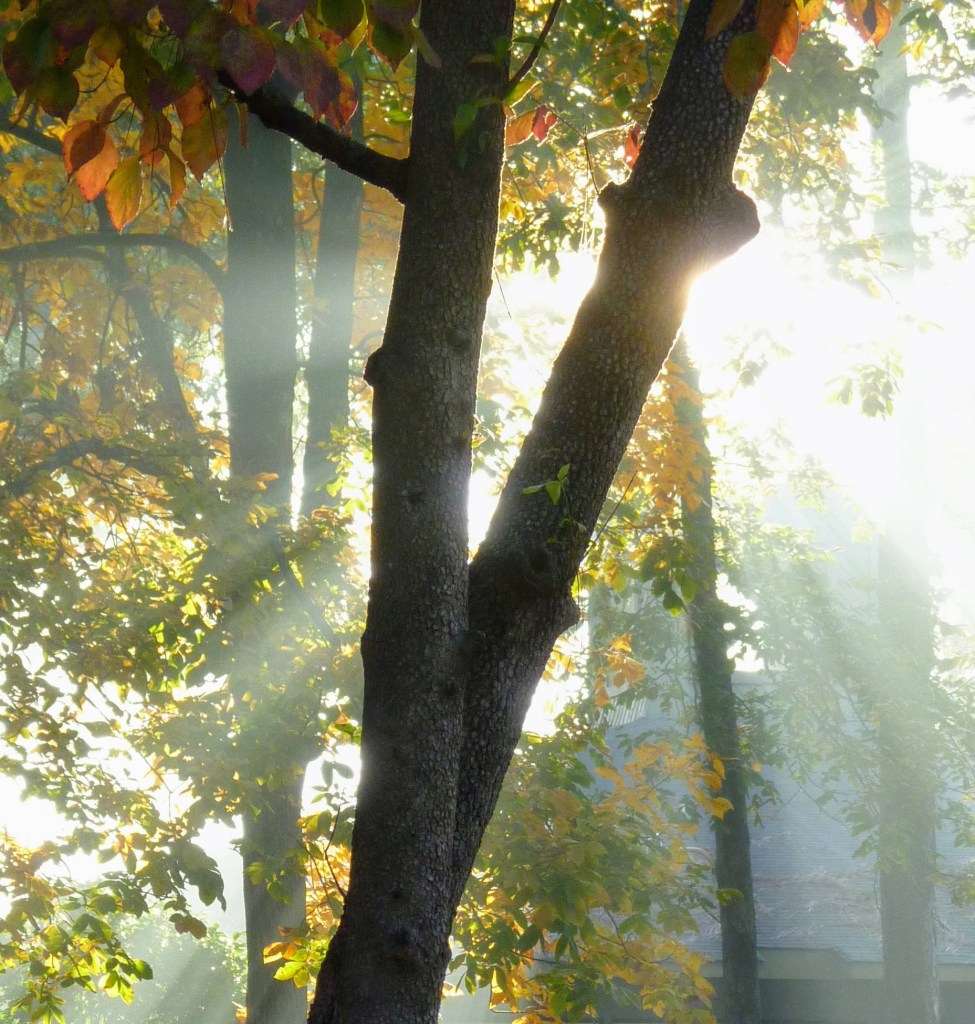
Like the slow defoliation of a great tree, Dale’s words began falling away.

It’s been the most shocking to me of all the losses so far, and the most challenging. As instructions became impossible for Dale to understand, I’ve had to depend on his willingness to follow as I guide us through each day.

Now few words remain. And those that do are as precious to me as the first words of a baby to a mother. Cherished. “Thank you.” “I love you.” “You’re good!” “You ARE!” “I know you!” “That’s stupid!” (Well, some cherished more than others.)

Dale and I are finding our way on new ground, without the familiar canopy of words. In its place, there is light…space…where other expressions grow: an outstretched hand, a smile, a soft pat on the back, shared laughter, a song, presence.

And in that space, love abides, words or no words.

The Gulf

Dale at Lake Murray, SC
Photo: Norma Sessions

“Moorings cast off, he is sailing away without me…”
 ~ my journal, May 2014

At the time I wrote those words, Dale’s new memories were veering farther away from any semblance of our shared past. Friendships with celebrities and exciting trips all over the world were becoming a part of our story.

More than this, though. Aspects of the man I had known for more than 30 years were changing:

  • Dale, the person who found joy in lively discussions about news and ideas, was having difficulty analyzing issues and events.
  • Dale, the one who added energy and laughter to any room he entered, was becoming quieter as following conversations became more challenging.
  • And Dale, the man whose sensitivity and understanding I treasured, could no longer easily see things from another perspective.

As these changes unfolded, a gulf developed between us where our familiar interactions had been. I found that I could no longer “think out loud” with him or talk in depth about things that were troubling me. Anything hypothetical was increasingly puzzling to him. Conversations about plans and decisions became too confusing. Even discussing the news was difficult because it was contaminated with his false memories. It felt like the tide of his disease was taking us away from one another.

More than this, though. It felt like Dale-himself was disappearing.

It was during this period that my brother David remarked: “The person you miss the most is sitting right beside you.” I can think of no better description for how it felt then…and how it feels now as the losses mount. It’s one of the many paradoxes of this journey: presence and absence, side by side.

This is what I keep learning: each disease-related loss creates a different version of Dale. No “shell” of himself, but fully present in both familiar and new ways. Different, not gone. Parts of him are no longer accessible. I miss those things. I grieve those losses. But he is still here.

Dale IS sitting right beside me. The gulf is bridged each time I meet him in the present moment. He has not sailed away. He has not disappeared.

He is still here.

Departure

Photo: Norma Sessions

“See? I remember that house! We were just here!”

We were on our way to spend time with friends at the beach and hadn’t been on this road in years. Dale sat in the passenger seat, pointing to houses, stores, even parked cars, repeatedly telling me that we had just seen each one.

Nothing like this had happened before in our short journey with Alzheimer’s disease. I had never even heard of such a thing, and it seemed especially strange this early in the process.

Over time these episodes became common and eventually were the norm. Almost everything new—people, places, things—became familiar to Dale and were woven into an ever-changing version of his past and ours.

As unsettling as they were to me, these recollections were clearly helpful for Dale. He would express great delight at having “just remembered” something, even telling his neurologist at Emory that his long-term memory was much better than mine. The new memories brought him happiness and a sense of fulfillment.

I learned to nod and respond positively to Dale’s memories. However, I was slow to join him in his happiness. It felt like our intertwined lives were being torn apart and taken in different directions.

In my mind’s eye, I could see the disease separating not only once-connected cells in the brain, but also much that had knit us together as a couple over the years. Our shared history—created together over decades of living and working together—was unraveling, disappearing.  

That which was a gift for Dale was a thief to me. 

How to reconcile these? Perhaps there is no way. They stand side by side in contrasting tones like so much on this journey: gratitude alongside grief, presence next to absence, moments of joy within the sorrow of decline. And I stand inside each paradox, mourning the losses…railing at the thief when I need to…and celebrating with gratitude the gifts where I can.

Early Signs

Photo: Norma Sessions

To most people, Dale seemed just the same: talkative, smart, friendly, warm, funny.

The first signs of the disease were subtle.

I remember being at a reception for a clergy friend of ours. Dale’s diagnosis was very new, and only those closest to us knew. A long-time friend greeted him and asked, “How are you, Dale?” He replied, “Well, I’ve got Alzheimer’s disease.” Knowing that Dale had always enjoyed teasing, the person laughed a little and said, “No you don’t. You’re joking.” Dale continued, “No, it’s true. I was just diagnosed at Emory. I’ve got Alzheimer’s disease.” The person was shocked.

That response became common as Dale shared the news with others. Even after we had moved into a retirement community and Dale had undergone brain surgery as part of a clinical trial, many seemed doubtful that someone with Alzheimer’s disease could acknowledge it and look as good as he did. “He seems fine to me!” is something I heard more than once.

I struggled with my response to these comments because to me, each disease-related change was jarring and heartbreaking, no matter how small. Dale-with-the-excellent-memory, the one who could always win at Trivial Pursuits: had already lost understanding of our finances; was having difficulty organizing his sermons; was forgetting whole conversations; was getting lost in his hometown.

For me, the early unfolding of the disease was…

… like listening to an orchestra play a favorite piece while musicians begin putting their instruments down one by one…

or

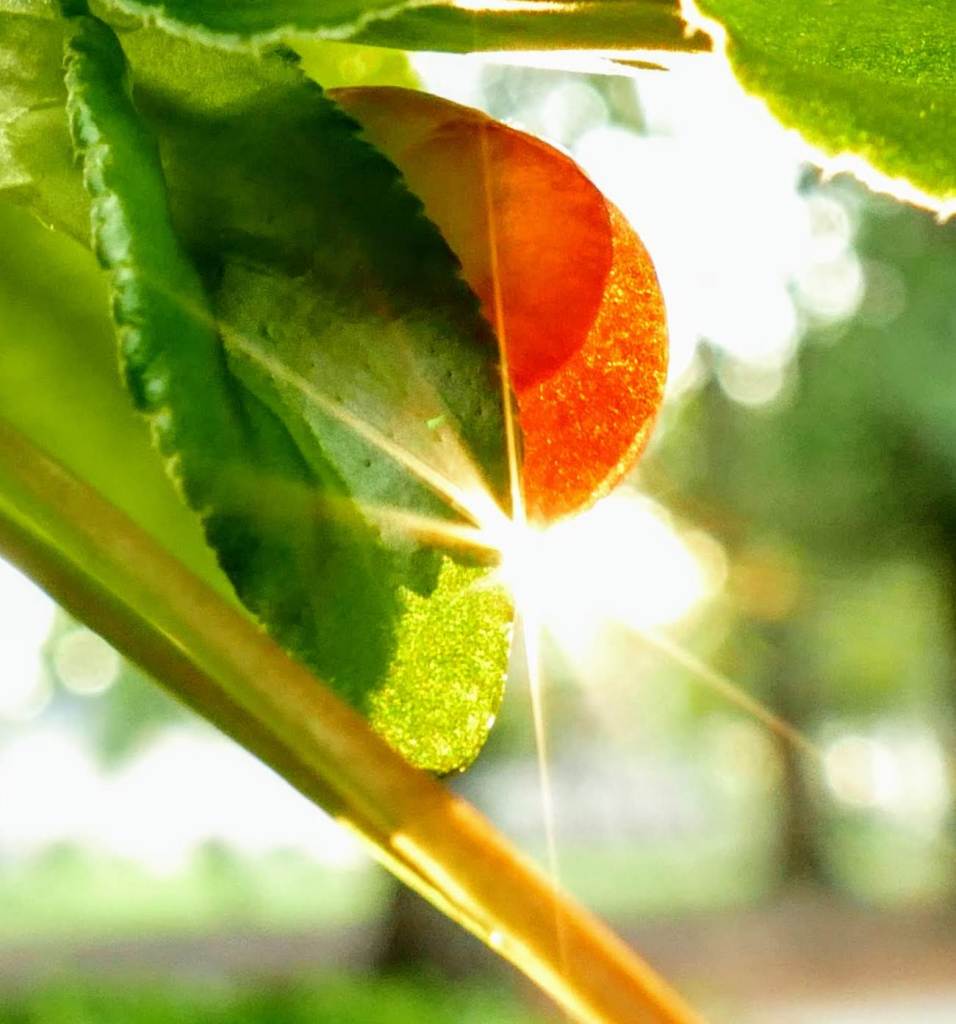
…like noticing the first blush of red on a leaf as summer draws to a close…

I longed for the melodies I no longer could hear, for the full sound of the whole orchestra. I dreaded the winter cold that was coming our way. The loneliness and grief of the journey had begun.

During this time, I came across a quote by Julian of Norwich:

“If there be anywhere on earth a lover of God who is always kept safe,
I know nothing of it,
for it was not shown to me.
But this was shown: that in falling and rising again
we are always kept in that same precious love.”

Surely, we have fallen and risen over the years of this journey. And just as surely, that same precious love, manifested and expressed in countless ways, has kept us both. The grieving is ongoing. So is the gratitude for the love that keeps us.

The Gift

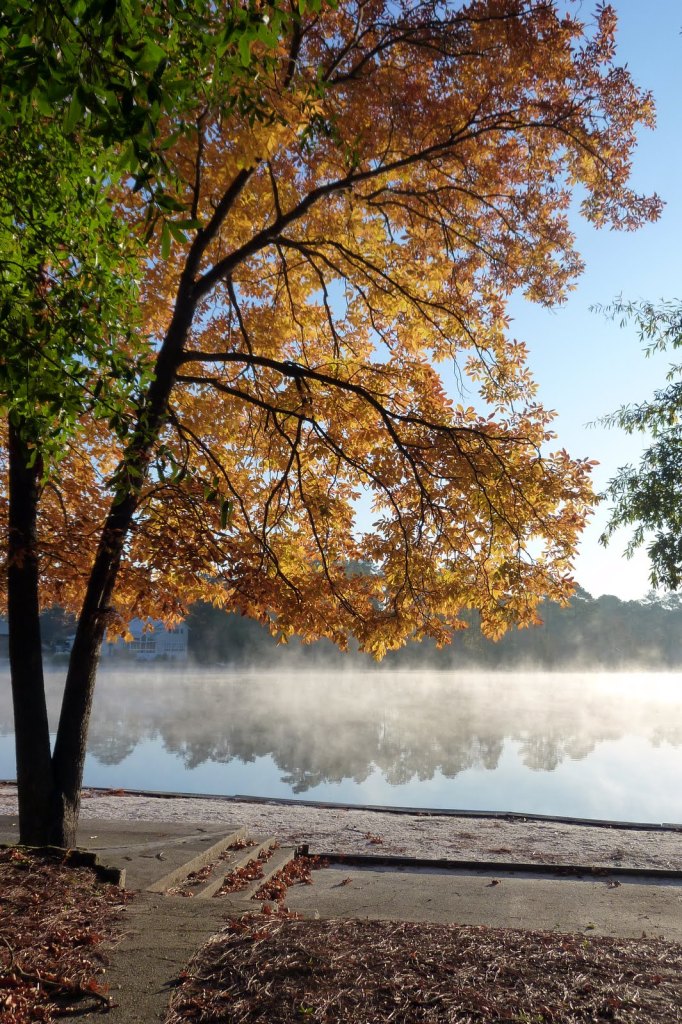
Morning mist, Columbia, SC
Photo: Norma Sessions

The loss of daylight hours that November matched my mood.

The news came by phone from the neurologist at Emory: “The result of the spinal tap confirms the other testing we did and tells us what we suspected. It is Alzheimer’s disease that is causing Dale’s symptoms.”

There was strange relief in knowing. We had no other way of explaining the unusual changes. But alongside the relief was a sense of dread: we both knew what was ahead. We had already witnessed the disease take the lives of Dale’s father and brother. The news that we would now watch it ravage Dale’s brain, stealing his memories and abilities, was devastating to me.

Holiday activities took some of our attention, as did selecting a clinical trial to join. It helped to have something to look forward to and feel as if we could make a difference for others. Still, the diagnosis was a new reality and we were struggling to adjust to it.

Seated on the couch in our living room two months after his diagnosis, Dale felt he received a gift, an “epiphany,” as he put it. He told me about it and wrote the following:

“Happiness,
I’ve learned,
is a gift
that only each person can find within
and choose freely
to embrace daily
come what may.
Having found this inside job/gift
I’m embracing it for all it’s meant to be…
for all of us.
It’s God’s free gift, with no strings attached!”

I watched Dale’s attitude shift as he internalized this message. His deeper acceptance of our new reality helped me. If he could live this way with a disease that was to steal so much from him, I could at least lift my gaze and walk with him.

Years later, a friend noted Dale’s happiness and remarked that perhaps a seed was planted when Dale wrote these words. Perhaps. There surely are mysteries to this process. What does remain as the disease cuts its swath through the brain? Intentions, capacities, and memories are lost in such unpredictable and heartbreaking ways. I know that the light I see in Dale now—his big smiles, easy laughter, and warm greetings—could be lost, too, at any moment. So, I am grateful for his happiness now, for whatever reasons it remains. May I learn more and more to embrace the gift for myself, “come what may.”

Postscript: Dale received his “epiphany” in January 2011. Here is a link to a video of Dale reading it in November 2015 during an interview conducted by Bishop Kenneth Carder for a Lutheran Theological Southern Seminary course on dementia: https://youtu.be/Sff-fgZ8Des

About this Blog

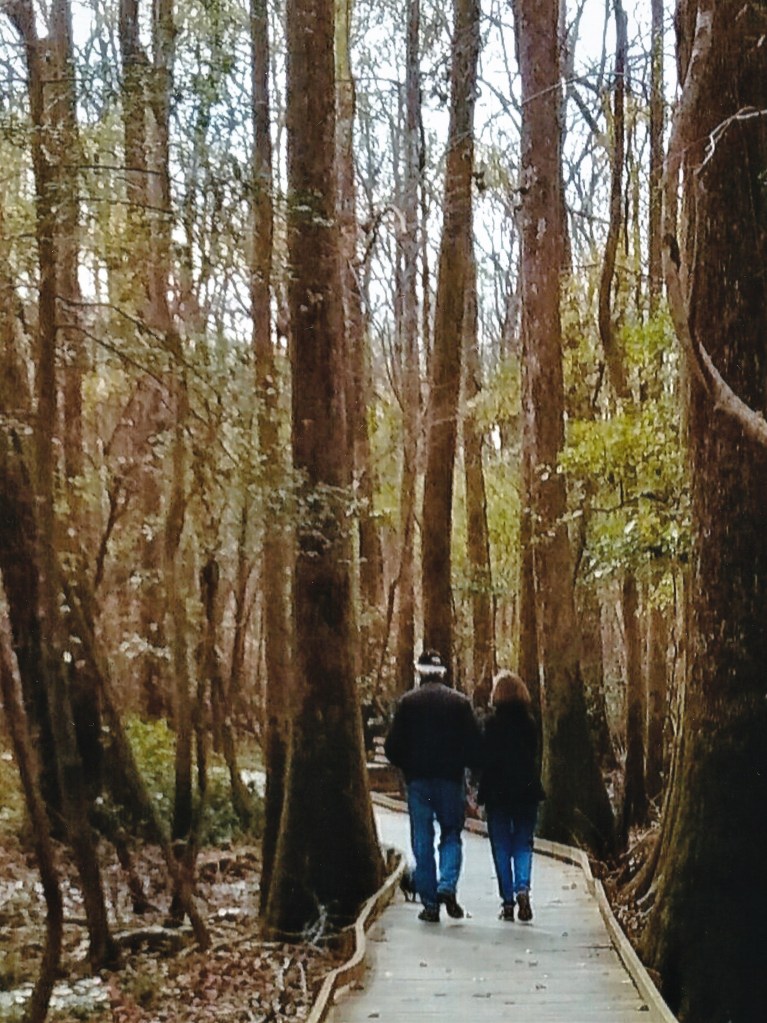
Congaree National Forest, December 2016
Photo: Donna Remke

I have been keeping a journal since my husband Dale was diagnosed with Alzheimer’s disease in 2010. My writing has helped me express difficult feelings, keep track of experiences, and cope with the innumerable changes that unfold with the disease. Recently I began to wonder whether my journal could be shared in ways that might also help others facing similar challenges.

As I reviewed the pages, I saw that I had used many images to describe what I was witnessing and feeling as Dale’s disease progressed. This was no surprise really, since images often come to me much more easily than words. I decided to try telling our story by pairing visual images—my photos—with reflections—my writing.

It is my hope that by sharing this way, I am carrying forward what Dale began when he accepted his diagnosis fully and openly. Because he had Alzheimer’s in his family, Dale had thought deeply about what he might do if he, too, had the disease. He sought an evaluation early, and when diagnosed, faced the disease head-on. He entered a clinical trial that involved brain surgery, not knowing for four years whether he had received treatment or placebo. Until the disease removed the memory of its presence, he told everyone he knew that he was living with Alzheimer’s. He walked bravely with that knowledge, hoping to reduce the stigma of the disease. He has been my hero all along the way.

Dale is now in middle stage Alzheimer’s. His verbal language is very limited and retention time is down to seconds. He requires guidance throughout the day and assistance with self-care. What he doesn’t need help with, though, is finding joy in the moment. He LOVES greeting and being with people, singing, dancing, and spending time with our dog, Lucky Day. Although he no longer has access to the memory of his diagnosis or understands what Alzheimer’s disease is, he continues to be an example of someone living fully with “what is.”

As Dale said in a video filmed in 2015 for a seminary course on dementia that we were a part of:

“Okay, this is it. I don’t like it. I didn’t want it. But I’ve got it. And I’m going to do the best I can with it.”

Me, too, Dale. Me, too.